|
American Architecture StylesSpecial Feature Publication: "ARCHITECTURAL STYLES AND TYPES IN BEVERLY HILLS-MORGAN PARK" HIGH STYLE ARCHITECTURE High Style Architecture | 19th Century Vernacular | Modern Style | 20th Century GOTHIC REVIVAL
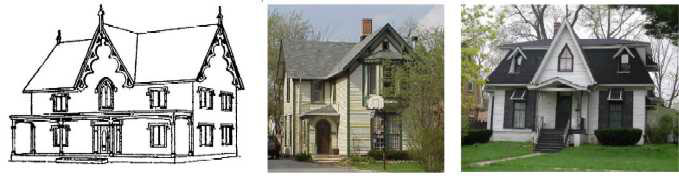
There are two variations of the Gothic Revival style in the area, Victorian Gothic Revival, popular in the Chicago area from about 1860 to 1880, and Late Gothic Revival, used from the late 19th century through the 1920s. Both types can be found in Beverly-Morgan Park. The Victorian Gothic Revival style takes its inspiration from Europe's great medieval cathedrals, which were characterized by verticality, structural expression, and richly carved stonework. The relationship, however, is more sentimental than literal. In Gothic Revival houses, steeply pitched gable roofs are often decorated with crisply cut ornamental bargeboard (commonly called gingerbread) or stickwork to suggest the home's underlying framework. Windows are tall and narrow and frequently have pointed arches. Built by local craftsmen, when these homes were constructed of wood they were sometimes called "Carpenter Gothic." As distinguished from early Victorian Gothic Revival architecture, the Late Gothic Revival style was popularly used for North American universities and other institutional buildings including churches. It is typically characterized by: towers and battlements with engaged buttresses and crenellations. Windows and door openings have Gothic (pointed) or Tudor (flattened) arches; some may have drip molds. Institutional buildings are frequently masonry: ashlar stone, or brick with stone trim, string courses, and window surrounds.
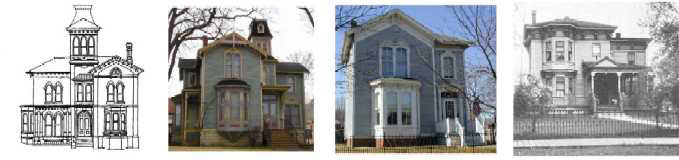
The Italianate style was a style popular in the United States from 1840 to 1880. It was based on informal, Italian style villas as a reaction to the formal classical ideals that had dominated art and architecture for about 200 years. Italianate style houses are generally characterized by a full two-story height with low-pitched or flat roof and overhanging eaves with decorative brackets. Tall, narrow windows are usually arched on top and there are often porches supported by slender ornamental turned or square posts.
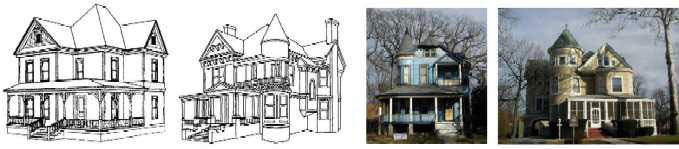
The Queen Anne style is one of several styles popular in America from about 1880 to 1910. Popularized by Richard Norman Shaw and other 19th century English architects, it has roots in styles prevalent during the Elizabethan and Jacobean eras in England. It is characterized by asymmetry and irregularity in its overall shape, facade, and roof. It often has gables, dormers, towers, and wings, with a partial, full-width, or wraparound porch. A variety of materials and patterns are used to break up the surface of the walls. The earlier homes have milled porch columns and balustrades, while those after 1893 (reflecting the influence of the World's Columbian Exhibition in Chicago) often have classical columns and simpler square balusters. These later examples are called Free Classic Queen Anne style houses.
The Stick Style is sometimes considered to be only a Victorian elaboration of the Gothic Revival Style, or a transitional style between the Gothic Revival and Queen Anne. The most distinguishing feature of the style is small vertical, horizontal, or diagonal planks placed on top of exterior walls. The style is often associated with houses featuring enormous, overhanging, second story porches, sometimes called "Swiss Chalet" houses. The style is also called "Eastlake" after British furniture designer and arbiter of good taste, Charles Eastlake.
The Shingle Style, popular between 1880 and 1900, is a variable style that borrows characteristics from several other styles. Many are closely related to the Queen Anne style with a facade that is usually asymmetrical, with irregular, steeply pitched rooflines having cross-gables and multi-level eaves. Others have Colonial Revival or Dutch Colonial style features such as gambrel roofs, classical columns, and Palladian windows. Large porches are also common. The distinguishing feature that sets this style apart is the use of continuous wood shingles cladding the roof and walls and wrapping the house like a skin. Shingled walls may curve into recessed windows. Sometimes even porches and stair rails are covered with shingles.
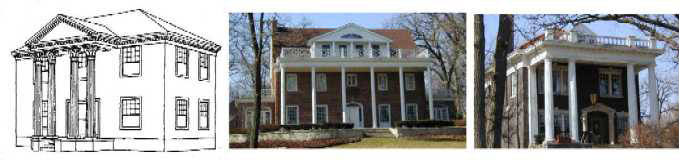
The Classical Revival style building is typically characterized by: a full-height porch with its roof supported by classical columns and topped by a pediment. Its facade is symmetrical, with a center entrance. A revival of interest in classical models began after the Chicago World's Columbian Exposition of 1893, which was attended by hundreds of thousands of visitors. The fair's planners mandated a classical theme, and when built, its buildings and public spaces were widely photographed. As a result, the revival of classical styles became fashionable throughout the country into the 1920s. The architects who had received training at the Ecole des Beaux Arts in Paris contributed to the influence of this style. Because of the style's monumental nature, it was more typically used for public buildings such as banks and museums.
The Colonial Revival style dates from the years following the 1876 United States Centennial Exposition held in Philadelphia. It was popular until the mid-1950s, as the country enjoyed a resurgence of patriotism after World War II. As the excessive variety typical of the Queen Anne style lost its attraction, a more literal traditionalism began to take the place of 19th century eclecticism. Colonial Revival became the most popular Historic Revival style throughout the country between the World Wars. Many people chose Colonial Revival architecture because of its basic simplicity and its patriotic associations with early American 18th-century homes. Most of these buildings are symmetrical and rectangular in plan. Some examples, more closely related to Georgian precedents, have wings attached to the side. Detailing is derived from classical sources, partly due to the influence of the classicism that dominated the 1893 World's Columbian Exposition. Many front facades have classical - temple-like - entrances with projecting porticos topped by a pediment. Paneled doors flanked by sidelights and topped by rectangular transoms or fanlights are common, as are multi-pane double-hung windows with shutters. Colonial revival houses built between the years of 1915 and 1935 reflect a DUTCH COLONIAL REVIVAL
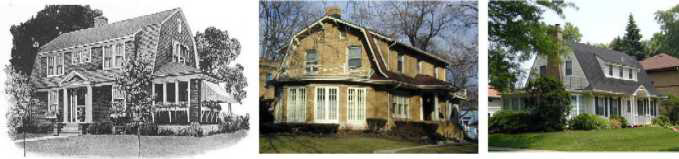
The Dutch Colonial Revival Style is a subtype of the Colonial Revival Style, marked by a gambrel roof, with a double slope on each side of the building. Generally faced in wood clapboard or shingles, it is derived from early Dutch houses built in the northeastern United States in the 18th century. Dutch Colonial Revival houses were built over a long period, as were other Colonial Revival homes - from the 1880s through the 1950s. Most have a symmetrical front facade and a classical entry portico. Those with the gambrel facing the street tend to be earlier, dating from the late 19th and early 20th centuries, while those with side-facing gambrels and a broad front dormer were very popular during the 1920s. CAPE COD
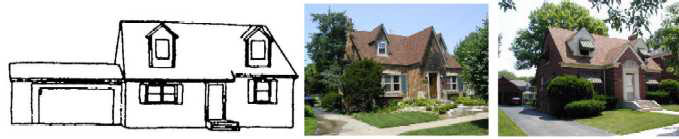
The Cape Cod style house offered home buyers a smaller but still traditional alternative to the typically two-story Colonial Revival style house. Loosely patterned after early wooden folk houses of eastern Massachusetts, the Cape Cod house is an 11/2-story version of the Colonial Revival style. It is characterized by a rectangular plan with a side gable roof, a central front entrance, and generally two front-facing dormers. There is frequently some classical detailing such as multi-light windows and classical door and window surrounds. SPANISH COLONIAL REVIVAL
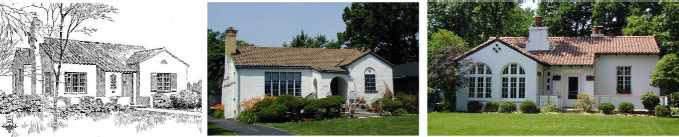
Spanish Colonial Revival architecture is fairly uncommon outside the southwestern states and Florida where Spanish Colonial construction actually occurred. It gained some popularity after the Panama California Exposition held in San Diego in 1915. Spanish Colonial Revival homes of various sizes, built during the 1920s and 1930s, are scattered around the country, and some are found in Beverly-Morgan Park. The style is typified by: low-pitched ceramic tile roofs, stucco wall surfaces, eaves with little or no overhangs, wrought iron work, and round-arched windows and doorways. ITALIAN RENAISSANCE REVIVAL
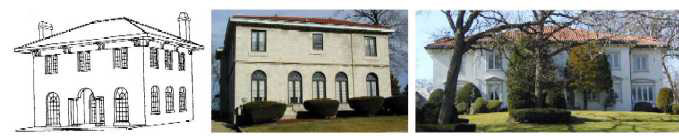
Although the Italian Renaissance Revival style was not as popular as other revival styles, there are examples found around the country, built between 1910 and 1930. This style differs from the earlier Italianate style that was popular in the 1860s and 1870s in two basic ways: buildings constructed in this style were somewhat more literal interpretations of Italian architecture, and they were generally designed by architects rather than being built from pattern books by local builders. The close resemblance to Italian architecture was possible because improved printing technology made photos of these buildings easily accessible to the reading public. Italian Renaissance Revival houses are usually constructed of brick or stone masonry. They are typically symmetrical with wings flanking the main body of the house. Roofs tend to be hipped with a low pitch, covered in ceramic tile. They have broad eaves that are supported by deep brackets. Upper story windows are generally smaller and less elaborate than the large arched openings beneath them, on the first floor. TUDOR REVIVAL
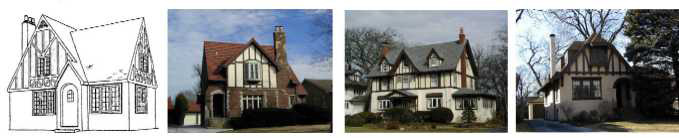
The Tudor Revival style is based on a variety of late medieval models prevalent in 16th century Tudor England. Although there are examples dating from the mid-1890s, the style was particularly popular during the 1920s and early 1930s. Associated with the country's early English settlers, it was second in popularity throughout the country, and in this survey area, only to Colonial Revival. All sizes of English homes appealed to the American family. The English manor house served as a prototype for estate houses, and the Cotswold cottage offered a romantic alternative for those looking for comfort in a smaller home. Tudor Revival houses are typically brick, sometimes with stucco. Half timbering, with flat stucco panels outlined by wood boards, is common. The style is characterized by steeply pitched gable roofs and tall narrow casement windows with multiple panes or diamond leading. The front door may have a rounded arch or flattened pointed (Tudor) arch. Many examples feature prominent exterior stone or brick chimneys. FRENCH ECLECTIC
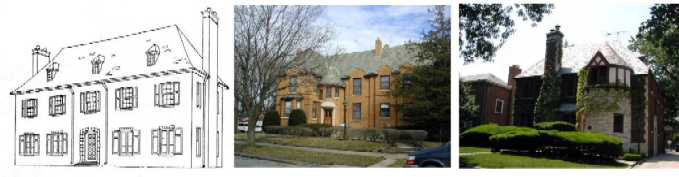
Although never as popular as Colonial or Tudor Revival, there are a number of fine French Eclectic homes in Beverly-Morgan Park. The style was fashionable in the 1920s, when many Americans who had served in France during World War I returned with first-hand familiarity with French prototypes. In addition, numerous American architects who designed these homes had received training at the Ecole des Beaux Arts and came back to America ready to apply what they had learned. The 1920s were a time when a number of photographic studies of modest French homes were published, both in architectural journals and popular magazines, providing architects and builders with many models to draw from. Stylistic features that characterize French Eclectic architecture include stucco or brick masonry walls and tall steeply pitched hipped or mansard roofs. The mansard roof, built throughout Paris during the mid-19th century, is designed with a steep double pitch to allow for an extra full floor of living area. There are two subtypes of French Eclectic architecture. The first is usually rectangular and symmetrical. In this type, the massive roof with its ridge paralleling the front of the house dominates, and the front and rear facades are symmetrical with a center entry. Frequently, wings are added to the sides of the main block. French classical manor houses provide the prototype. The second, more common subtype is asymmetrical, usually L-shaped in plan, with an off-center doorway frequently located in the corner in a prominent cylindrical tower topped by a steep conical roof. Sometimes these homes, patterned after rural Norman farmhouses, contain half timbering.
|
||||||||||||||||||||||||||||||||||||||||||||||
| home | company background | woodcarving & sculpture | period furniture custom built-in's | services | commissioning process museum/historical affiliations | educational services | craftsmen links sitemap | search |
|||||||||||||||||||||||||||||||||||||||||||||||
Artisans of the Valley Hand Crafted Custom Woodworking Stanley D. Saperstein Eric M. Saperstein Our studio and showrooms are open by appointment. Please call ahead so we don't miss you! (609) 637-0450 Fax (609) 637-0452 e-mail: woodworkers@artisansofthevalley.com |